A WhatsApp CRM for jewellers: from an Instagram enquiry to a store visit
Last reviewed: October 2026 ·Questions? →
Klaros is a WhatsApp CRM for jewellers in India. It knows each piece in your stock by its tag, weight, stones and BIS HUID, prices it the way your bill does from the day's gold rate, answers customers on WhatsApp from those facts, and books them into a visit at the showroom they choose. Klaros for Jewellers is ₹4,999 a month per showroom, billed annually. It is not billing software.
A customer who saw a piece on Instagram can open it up close, ask at nine at night whether it comes in their size and be answered from your own facts, and talk to someone on your team when they are ready. Change the rate in the morning and the catalogue, your WhatsApp storefront and the answers in chat all move together. A gold savings scheme can run at your counter and on WhatsApp, in pilot today.
A piece, priced the way your bill prints it
An 18K necklace set with two qualities of diamond and three rubies, at a morning rate of ₹11,660 a gram.
Tomorrow's rate reprices it on its own. A stone with carats and no rate, or a making charge with no kind, is refused rather than priced at zero, so a piece is never sold at the price of its gold.
Klaros at a glance
The short answers a jeweller asks first, each stated further down this page.
| What it is | A WhatsApp CRM for jewellery shops: your pieces, your customers and their conversations in one place, on the WhatsApp Business Platform. |
|---|---|
| Who it is for | Jewellers in India selling gold, silver and diamond jewellery, from one showroom or several. |
| Hallmarking and GST | A gold piece of 2 g or more is not offered until its BIS HUID is recorded. Every price includes GST at 3%. |
| Your stock | Imported from your billing software's export or your own spreadsheet, as it already is. |
| WhatsApp message charges | Paid to Meta directly, at Meta's rates. Klaros adds no markup. |
| Price | ₹4,999 a month for the first showroom, billed annually, and ₹2,999 for each additional showroom. What it includes |
| Where it runs | Hosted for you, or self-deployed in your own Cloudflare account, with a public API and a full data export. How deployment works |
| What it is not | Your billing software. GST invoices, old-gold exchange, girvi and your books stay where they are. |
Comparing WhatsApp CRMs for jewellers? The jewellery buyer's guide lists eleven requirements and the question to ask any vendor about each, with Klaros's own answer beside it.
What the WhatsApp CRM does in a jewellery shop
One rate per purity, every piece follows
Set 22K, 18K and silver each morning. Saving reprices every piece at once, and a nightly run catches the rest. The board shows yesterday and the day before. A price whose rate is more than 36 hours old is held back rather than quoted.
Making, stones and charges as you bill them
Making charge per gram, as a percentage or flat, with a minimum if you set one ("12% or ₹500, whichever is higher"). Stones line by line, as carats times rate per carat or a fixed amount. The hallmarking charge, if you pass it on. GST at 3%.
No HUID, not on sale
One row per tag, grouped into its design. A gold piece of 2 g or more is held back from the storefront and from chat until its BIS HUID is recorded. Type it, or read it from a photo of the hallmark certificate: a carat or weight that disagrees with the piece is pointed out, and nothing is saved until you save. Kundan, polki and jadau pieces can be marked exempt, and a shop the Hallmarking Order exempts can say so.
Imported as it already is
Export from your billing software, or use your own spreadsheet. Tag No, Net Wt, MC/gm, VA %, Dia Wt and Dia Amt are read by name. A gross weight on a stone-set piece has the stones' weight taken out when their carats are given. If your list says 916 and your board says 22K, you say it once.
Pieces a customer can tell apart
Each tag is listed with its purity and weight in its title (22K · 3.980 g), and with its stones and its HUID. New prices go to your WhatsApp catalogue when you save the rate. A cart filled at yesterday's price is charged today's, and the customer is shown why. How the WhatsApp catalogue is kept true
"What is today's rate?" answered
From your own board, with yesterday's and the day before, and the price of a sovereign for those who ask for one. Asked about a piece, the assistant quotes its listed price and can say what each stone is.
From an Instagram post to a store visit
Footfall you can trace: a customer sees a piece online, books a store appointment or a video consultation, walks in, and the sale is counted against the post or ad that brought them.
One page per piece, the price a tap away
Wherever a piece appears, in a card, a carousel or a link, "See it up close" opens its own page: the video first, every photo, each size as ready or made to order, every fact you have recorded, and the full price tag at today's rate when the customer asks for it.
Similar means the same kind of piece
Each design carries its kind of piece (with its Tamil and Hindi names), work, motif, finish, occasion, stone colour and weight band, read from the product name where it can be. "Similar designs" compares on those, inside the same category, so a temple necklace is not answered with a chain.
"Is it available? Size 14? Price?"
Asked about the piece in the chat, these are answered at once from your own facts, with no AI and nobody on duty, and so is "where is your shop?". The price comes as the full tag at today's rate, never a number typed in the chat. Anything you have not entered is left for your team.
Book a visit, or a video call first
From the piece's page a customer can talk to someone now, while a person on your team is on duty, or book a time within your hours. "Keep it for my visit" asks you before anything is promised; you reply "kept" or "not here". A video call is offered only once your shop has passed a test call and switched it on.
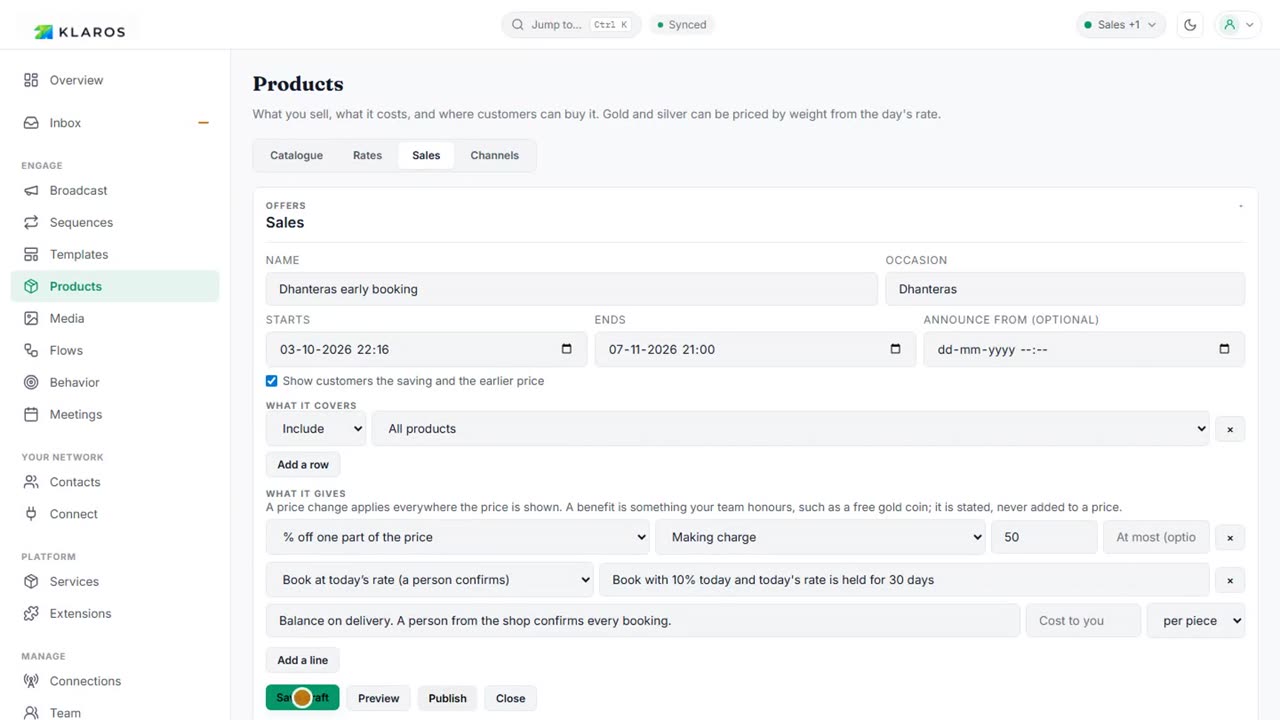
An offer on making charge follows the rate
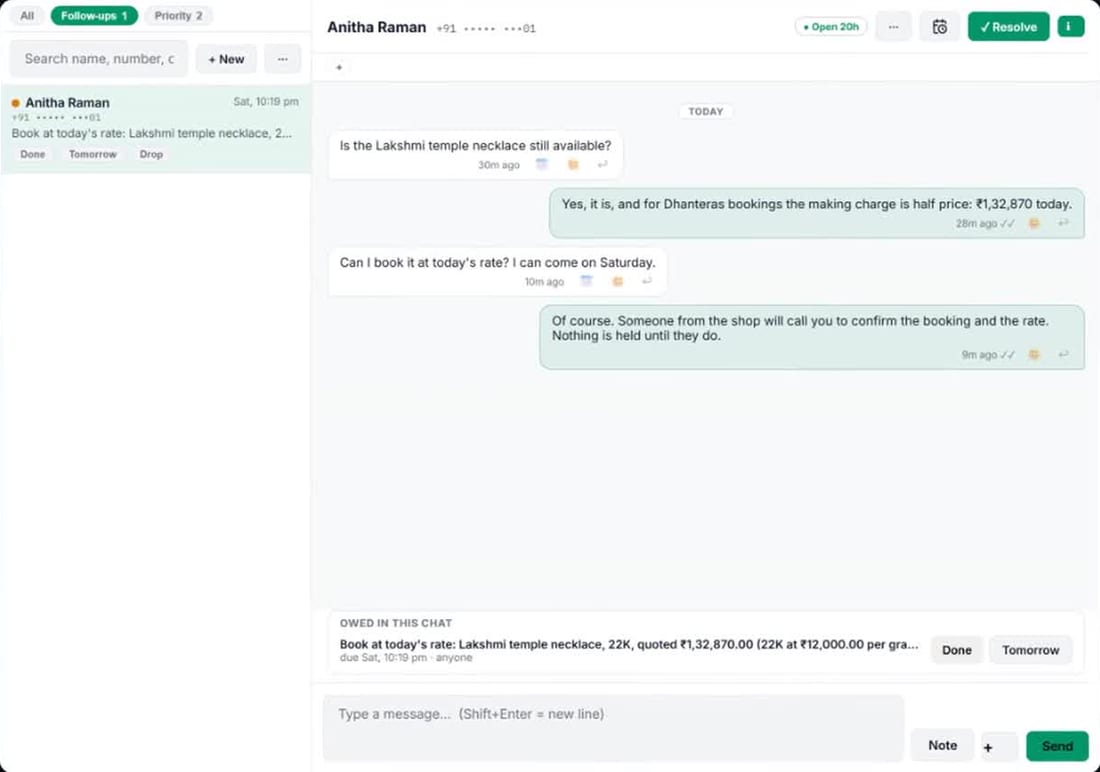
Half off the making charge for Dhanteras is worked out again from each morning's rate, so the offer stays right when gold moves. "Can I lock today's rate?" goes to your team with the exact price and rate quoted, and the customer is told nothing is held until you confirm.
Which post brought the walk-in
The commonest jewellery sale starts on WhatsApp and is paid in cash at the counter. "Already paid at the counter?" in the chat records it (cash, UPI to the shop, card machine or bank transfer), so the sale is counted against the post or ad the customer came from.
Watch it on a jewellery shop
Two films recorded on the real product. Where a film shows something that has changed since, it says so above the player.
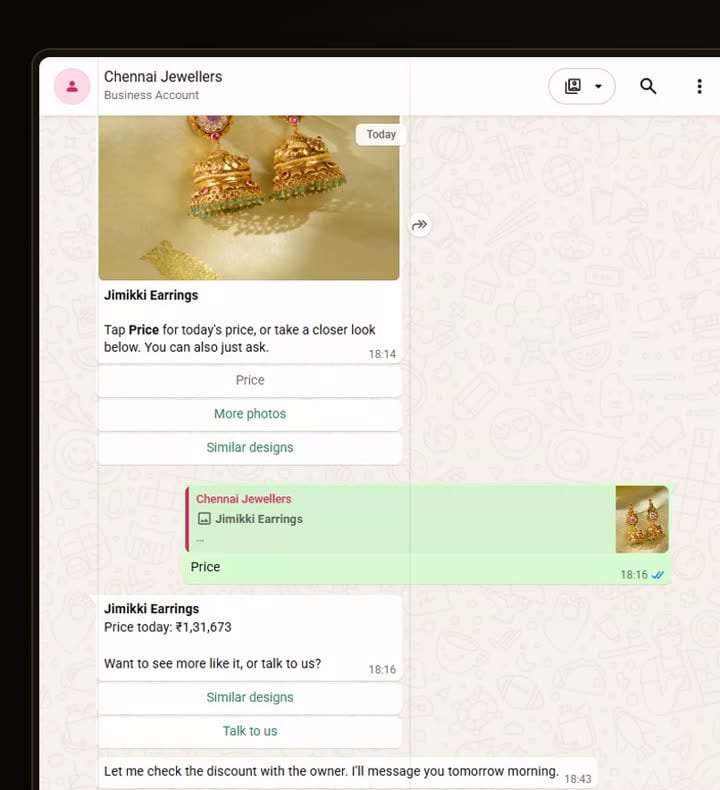
The Modern Shopper: from an Instagram post to a WhatsApp conversation
7 min 41 s. A pair of gold jimikki earrings is posted, a stranger comments "price ?", and the shop answers, moves her to WhatsApp, remembers what she said and keeps its promise to write back.
The illustrated scenes (the shop, the customer, the street) are AI-generated people and places, not a real shop. The screens are recorded live, with a test customer whose number is masked. The Instagram replies need the Instagram extension, a paid add-on.
A festival offer that follows the gold rate
3 min 36 s, with sample shops and customers. The jewellery shop starts at 2:04; before that, a saree shop shows how customers who asked about offers are told when the sale opens.
Read the jewellery part of the transcript
Now gold, where the price changes every single morning.
Sri Lakshmi Jewellers opens its Dhanteras bookings early, with half off the making charge. Not the gold, the making charge. Klaros works it out from the day's rate: ₹1,18,450 becomes ₹1,10,725, tax and all.
Next morning, gold jumps to ₹12,000 a gram. You don't touch the sale. The offer simply follows the rate: ₹1,32,870.
And when Anitha asks, can I lock today's rate, Klaros doesn't make promises with your money. It hands her request to your team, with the exact price and rate she was quoted, and tells her honestly: nothing is held until the shop confirms.
Your team sees it first thing: who, what, and at what price. Ready for a call.
The shop and customer names are samples, not real businesses or people.
Several showrooms, one catalogue
For a brand with more than one showroom: each one takes its own bookings, and the catalogue and the data stay yours.
Its own hours, number and team
Every showroom has its area, address and map pin, its opening hours (or the brand's), how many visits it can take at once, the WhatsApp number it answers on, and the staff who work there.
The customer picks the showroom
Booking a visit asks which showroom first, theirs at the top. "Use my location" sorts them by distance on the phone itself, and the position never leaves it. A visit can be moved to another showroom later.
The showroom's own staff hear first
A request goes to the people at that showroom, and to everyone if none of them is available. The confirmation, the reminders, the inbox and the morning list all say which showroom.
Thirty days, per showroom
Visits requested, booked, kept and missed, for each showroom, so you can see which showroom online customers actually reach.
Stock and the morning rate, pushed by API
Your ERP or billing system can set a piece's stock and push the day's rates through the public API, which reprices the pieces priced from them. A spreadsheet export works too. Stock is held for the brand, not per showroom.
In your own cloud account
Klaros is self-deployed: it runs in your own Cloudflare account, so customer conversations and records are yours. A public API, an MCP server for your AI tools, and a full export are included.
Already on Shopify?
For a brand, or the agency that runs its store, whose catalogue has outgrown Shopify apps and metafields.
What comes across
Your Shopify product export arrives whole: every photo in order, and every variant under its product with its own SKU, price and stock. Weight, purity, making charge and stones are added once, and every price after that follows the morning rate.
What a pricing app does not do
Each stone on its own line, HUID enforced before a piece is sold, no price quoted from a rate more than 36 hours old, and the same catalogue in the WhatsApp conversations where customers ask about it.
What it does not do yet
Klaros does not change prices on your Shopify store: a live sync with a Shopify store is not offered yet. Until it is, Shopify stays your website's storefront and Klaros prices the catalogue customers browse and ask about on WhatsApp. Running stores for several brands? See Klaros for agencies.
Your gold savings scheme, at the counter and on WhatsApp
Savings Plans has been running with one jewellery shop since October 2026. It is not in the extension catalogue yet: we switch it on with you, after going through your terms together. Gold savings scheme software, in full
Terms first, in the customer's own numbers
No payment is taken until the customer has accepted a Key Facts Statement worked out in their own figures. A nominee is recorded at enrolment. Money moves only at the counter, where a person confirms the amount.
Rupees or grams, each purity at its own rate
Save in rupees, or in grams of 22K or 24K, each priced from that purity's rate on your board. A payment taken before the day's rate is set waits for it. A plan can save towards a whole 10 g 24K coin, and the owner is told to have it ready when it is reached.
Closed within the year, taken as jewellery
A plan closes by day 364 and nothing is paid back in cash: what is unused is billed as goods and held for the customer. The reward is a discount on jewellery, shown in rupees, at most 12% a year for a customer who pays every instalment on time.
One price for a piece bought with savings
The piece is priced from the same walk-in tag as every other sale, so there is no separate scheme price list. The making charge is shown in rupees and in grams of the piece's gold, and the discount comes off before GST.
"How much have I saved?"
Answered from the customer's own account, and only to the number that holds the plan: what is paid and held, what is due next, and what it is worth as jewellery today. "What would I get if I closed it?" is answered too, and "skip this month" is confirmed with a Yes or No tap.
What the scheme owes, and a file for your auditor
Advances by age, grams owed per purity, goods held for customers, and collections against your net worth if you enter it. KYC is asked for above ₹2 lakh, and you are told as one customer's cash nears ₹10 lakh in a year. The auditor's download carries no names or numbers.
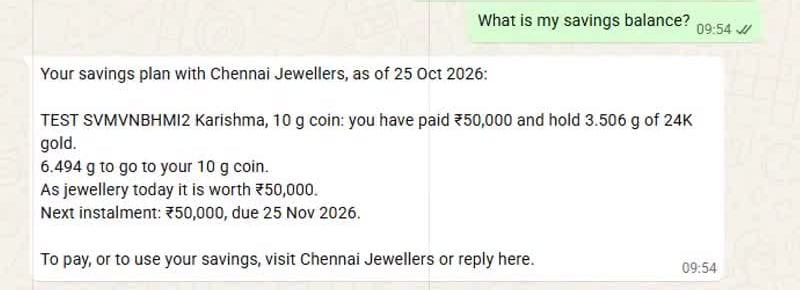
A gold savings plan, run end to end on a real shop
4 min 32 s, on the live product: the counter screen, the customer's WhatsApp, the API and an AI assistant over MCP, then a year of the plan simulated. The "real jewellery shop" in it is our own demo shop, run as a real one, with a test customer.
Recorded on 25 October 2026 under the shop's first terms, hours before today's terms replaced them. Three things in it are no longer offered on new plans: the reward described as what the customer "earns" (0:38, now a discount on jewellery), cash that could be asked back (1:50), and the refund in cash when the customer stops (3:11; what is unused is now billed as goods and held). A new plan no longer starts on its own after the coin unless the shop turns that on.
Whether your scheme is lawful is yours to settle
Klaros runs the terms you publish and keeps every rupee and gram accounted for. It does not decide whether a scheme meets the deposit rules for your shop's legal form. Settle that with your own adviser before you enrol anyone.
Tested on a working shop, not a mock-up
Klaros keeps a jewellery shop on the live service for testing: a real catalogue on a real WhatsApp number, taken through a customer's journey from the first message to the counter. What testing has shown, with dates:
-
A stock list written in a billing system's own words, with a blank row and a duplicate design number left in on purpose, was imported on the live service. It found six defects no test had caught, and the fixes followed within days.
-
The festival-offer film on this page was recorded with every one of its 43 checks passing: the offer recomputed from the morning's rate, and "can I lock today's rate?" handed to a person.
-
A gold savings plan was run on the live service from enrolment through instalments to closing: 28 of 28 checks passed.
-
What went wrong. A payment receipt sent more than 24 hours after the customer's last message failed, because the shop had switched Savings Plans on before its receipt templates existed. It was fixed the same day: a shop's new message templates now go to Meta on their own within 15 minutes, and Meta approved the shop's four savings templates within the hour.
No jeweller is named on this page and no quote is invented. When a shop agrees to be named, its own words go here.
What it costs
One price per showroom, for less than the same plan and extensions bought one by one.
Unlimited staff, and setup done with you on annual plans: your stock list, your number and your message templates. Instagram is a ₹799 a month add-on, and Savings Plans is in pilot and priced after it. WhatsApp's own message charges are paid to Meta directly, at Meta's rates. Full pricing → · Each extension's own price →
What you turn on
Each is its own extension in the catalogue, off until you switch it on. Turn on only what you use.
Jewellery
The rate board, pricing by weight, stones, HUID, the stock-list import and the rate answered in chat.
Meetings and Retail operations
Store appointments from a piece's page. Retail operations adds showrooms, each with its own bookings and team. The Meetings extension
Savings Plans
In pilot: switched on with you rather than from the catalogue.
WhatsApp Catalog Publishing
Your pieces in the catalogue customers browse inside WhatsApp, kept at today's prices.
AI Tools
The assistant that answers questions about your pieces and quotes them from your prices. The AI Tools extension
Commerce & Payments
A cart becomes an order and a payment request, to your own payment gateway. The Commerce extension
What it is not, plainly
Klaros is not your billing software. GST invoices, old-gold exchange, karigar accounts, girvi and your books stay where they are. Stock is not read from your billing software on its own: mark a piece sold when it sells at the counter, or have your system push stock through the API. Stock is held for the brand, so Klaros does not say which showroom has a piece. And a hold or a discount is your decision to make with the customer; the assistant quotes your listed prices and has no way to change a rate or a making charge.
Common questions
How much does Klaros cost for a jeweller?
Klaros for Jewellers is ₹4,999 a month per showroom, billed annually, and ₹2,999 a month for each additional showroom. It includes the Starter Cloud plan and the Jewellery, WhatsApp Catalog Publishing, Meetings, Commerce & Payments and AI Tools extensions, unlimited staff, and setup done with you. Bought one by one they cost ₹6,694 a month. Billed monthly it is ₹5,999 a month plus ₹9,999 for setup. WhatsApp's own message charges are paid to Meta directly.
Do I have to type a price for every piece?
No. Give each piece its net weight, purity and making charge, and its stones if it has any. The price is worked out from the rate you set in the morning, and it changes when the rate does. A piece with a fixed shelf price keeps it, and a made-to-order piece stays "price on enquiry".
What happens if I forget to set the rate?
Prices stay as they were until the rate is 36 hours old, then the pieces priced from it are held back from the storefront rather than sold at an old rate. The automatic answer to "today's rate?" is not sent either, so nobody is told yesterday's rate as today's.
My stock list says 916 and my board says 22K. Do I keep two rates?
No. The board shows "916 has no rate" and lets you price it as 22K. You say it once, and the pieces follow the 22K rate from then on.
How are diamonds and other stones handled?
Line by line, the way a bill prints them: the kind of stone, pieces, carats, quality, and either a rate per carat or a fixed amount. A laboratory-grown stone is recorded as one and named in full on your storefront.
Does it replace my billing software?
No. Klaros is where your customers find your pieces and ask about them, on WhatsApp. Your billing, GST invoices, old-gold exchange and accounts stay in your own books or software.
Can I run my gold savings scheme in Klaros?
Yes, as a pilot. Savings Plans covers enrolment with a Key Facts Statement, instalments in rupees or grams, a 10 g coin goal, the bill for jewellery bought with savings, and the customer's questions on WhatsApp. It is switched on with you rather than from the catalogue, and your scheme's terms and their legal standing stay your decision.
What does a customer get if they message at nine at night?
If they ask whether a piece is available, whether it comes in their size, its price, or where your shop is, the answer comes at once from what you have entered, with no AI and nobody on duty. The price is shown as the full tag at today's rate. Anything you have not entered waits for your team.
My shop is exempt from hallmarking. Are my pieces still held back?
Not once you say so. Beside the HUID bar in Products, an admin can declare the exemption that applies, a district the Hallmarking Order does not cover or a turnover up to ₹40 lakh, and tick that it is true. Who declared it and when is shown, and it can be withdrawn.
Can a customer talk to someone before they come in?
Yes. From the piece's page they can talk to an expert now, while someone on your team is on duty, or book a time within your hours. "Keep it for my visit" asks you first, and you reply "kept" or "not here". A video call is offered only after your shop has passed a test call and switched it on.
We have several showrooms. Can each take its own appointments?
Yes, with Retail operations. Each showroom has its own hours, booking capacity, WhatsApp number and staff. The customer picks the showroom when booking, the request goes to that showroom's team, and you see visits requested, booked, kept and missed per showroom over thirty days.
Can our ERP push stock and the day's gold rate?
Yes. The public API sets a piece's stock and takes the day's rates, which reprices the pieces priced from them. Stock is held for the brand, not per showroom.
Can Klaros keep our Shopify store's prices in step with the gold rate?
Not yet. Your Shopify export imports whole, with every photo and variant, and Klaros prices that catalogue from the morning rate for WhatsApp. It does not change prices on your Shopify store, because a live Shopify sync is not offered yet.
Bring your stock list. We will price it with you.
Send us the export from your billing software or your spreadsheet, and we will set up the catalogue with you. Comparing options first? The buyer's guide lists what to ask any vendor.