WhatsApp BSP Markup Index (2026)
Most businesses pay 12–39% more per message than Meta's published rate. No major BSP discloses this — the markup is baked into your per-message rate, invisible on your invoice. This index documents what each provider actually charges.
Your bill has two layers. Most people only see one.
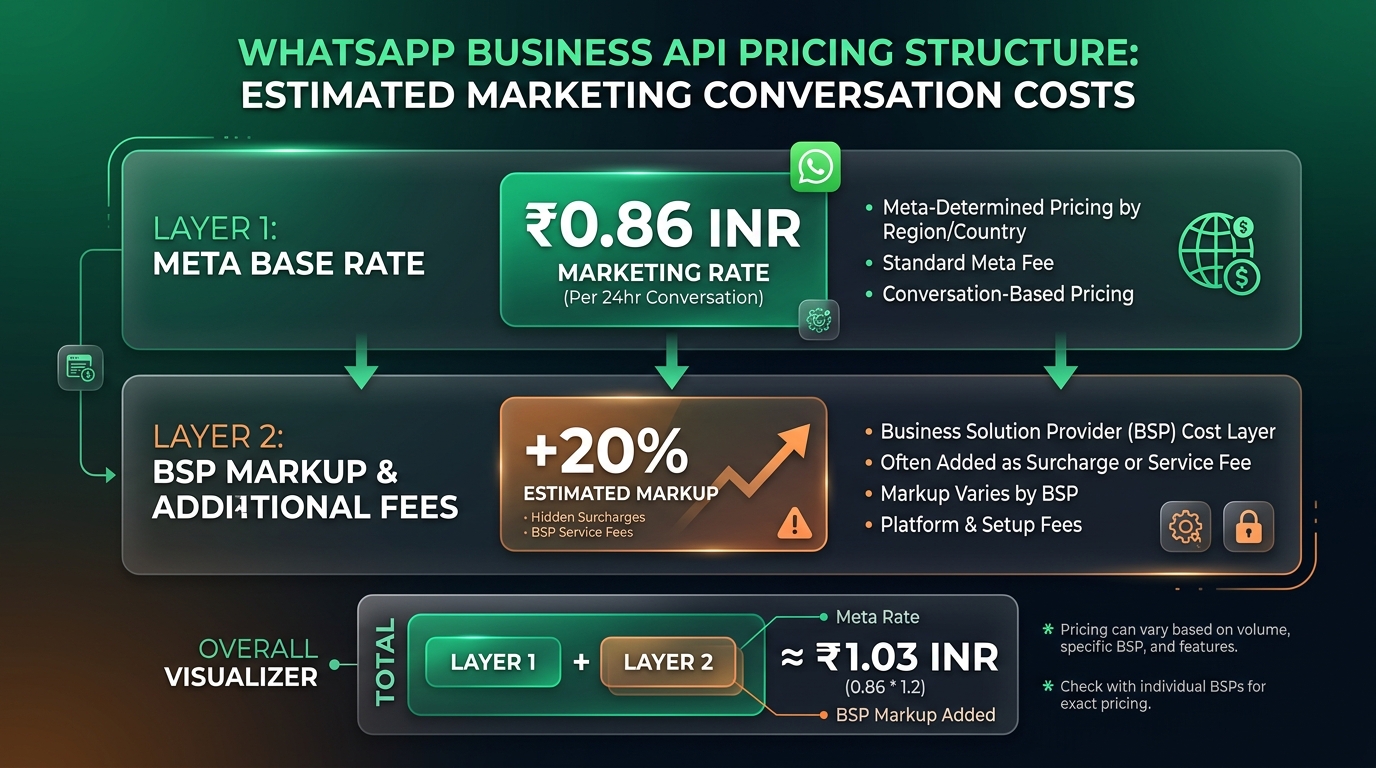
WhatsApp API pricing involves two completely separate cost layers. Your BSP invoice combines them — without separating what Meta charges from what the BSP adds on top.
The base rate
Fixed. Universal. Set by Meta. Identical regardless of which BSP you use. Determined by the recipient's country and message category.
India Marketing ₹0.8631/msg India Utility ₹0.1150/msg Service: Free*The markup
Variable. Hidden inside your per-message rate. Rarely disclosed as a separate line item. Ranges from 0% to 39%+ depending on provider and plan.
WATI ~20% Take Blip ~25% Interakt 10–39% AiSensy ~19%* Free service messages capped at 1,000 per phone number per month from October 1, 2026. See service message billing note.
Unsure how much Layer 2 markup you're paying?
Enter your last monthly BSP invoice into our free Bill Auditor. We'll reconcile your line items against Meta's official rate card in 30 seconds.
Three pricing models — they're not all the same
BSPs charge for their markup in fundamentally different ways. Understanding the model matters more than comparing headline subscription prices.
| Model | How it works | Best for | Risk at scale | Examples |
|---|---|---|---|---|
| Percentage markup Variable cost |
BSP charges Meta's rate × (1 + markup%). As your volume grows, so does the absolute markup in rupees or dollars. | Low-volume senders who value platform features over cost | High. Markup scales with volume — at 100k msgs/month, a 20% markup is a large monthly line item. | WATI, Interakt, AiSensy, Respond.io, Gupshup |
| Flat per-message surcharge Fixed cost |
A fixed amount (e.g., $0.005) added per message, regardless of category or country. Predictable but blind to Meta's rate variation. | Developer-first teams who prefer predictable unit economics | Medium. For low-cost categories (Utility at ₹0.115), a $0.005 surcharge can be a larger percentage than it appears. | Twilio |
| Flat subscription + zero markup No per-msg cost |
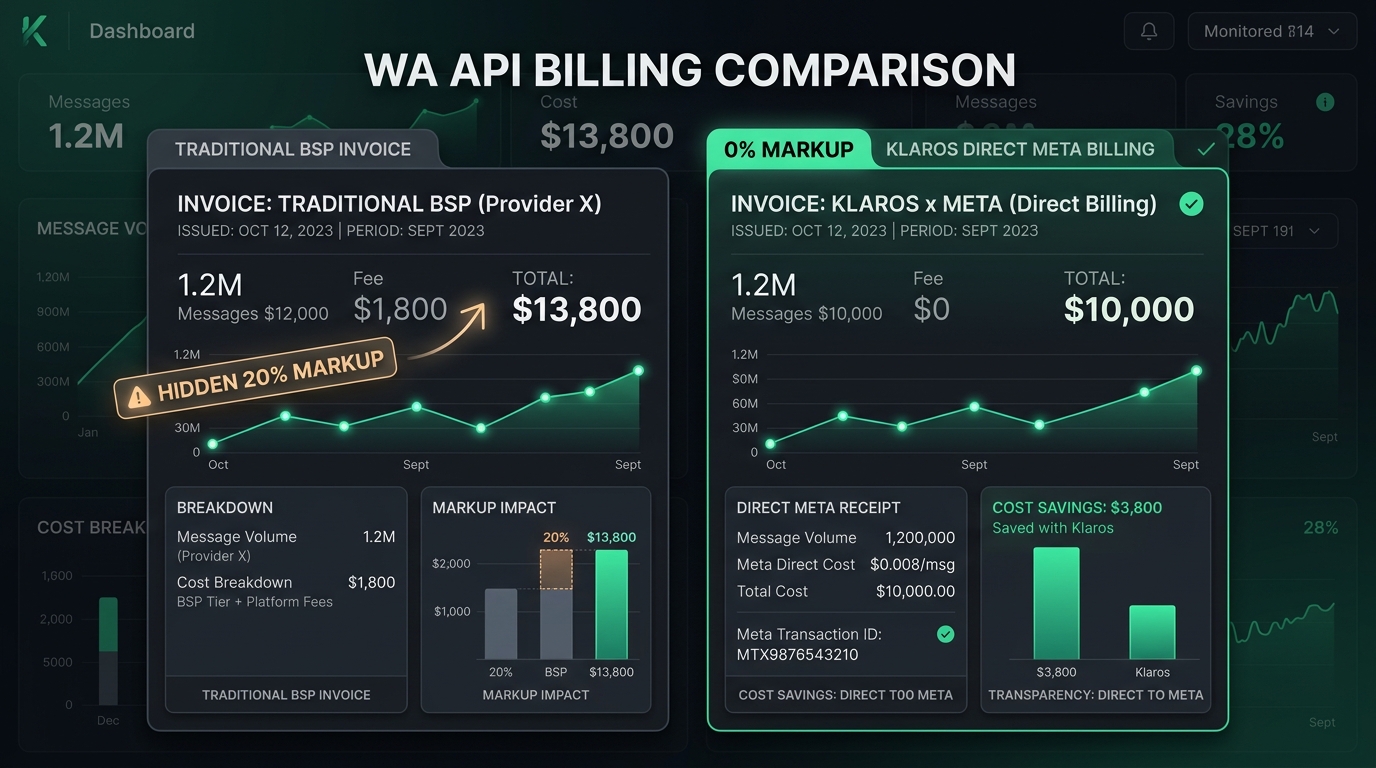
Monthly platform fee covers software access. Meta's base rates pass through at exactly Meta's cost — 0% markup on messaging. | Mid-to-high volume senders where per-message markup becomes the dominant cost | Low. Cost is predictable. Higher fixed monthly fee, but no variable markup eating into margin at scale. | 360dialog, Klaros |
BSP Markup Index — 19 providers audited globally
Annual markup tax calculated at 50,000 msgs/month (India baseline rates, 60% Marketing / 40% Utility). Markup estimates from third-party rate card audits across North America, LatAm, Europe, Asia-Pacific, and Middle East.
| Provider | Region / Market | Starter Plan ($/mo) | Markup model | Est. markup | Wallet required | Annual markup tax (50k msgs/mo baseline) |
|---|---|---|---|---|---|---|
| Klaros | Global | $8 | Flat sub + 0% markup | 0% | None (direct Meta billing) | ₹0 / $0 |
| 360dialog | Europe / Global | ~$53 (€49) | Flat sub + 0% markup | 0% | None (direct Meta billing) | ₹0 / $0 |
| Rasayel | Middle East / Global | $120 | Percentage markup | ~15% | Prepaid credit | ~₹50,748 (~$608) |
| Respond.io | Global / SEA | $79 | Percentage markup | ~15% | Prepaid wallet | ~₹50,748 (~$608) |
| Gupshup | India / Global | $25 | Percentage markup | ~18% | Prepaid wallet | ~₹60,900 (~$730) |
| Gallabox | India / Global | $40 | Percentage markup | ~18–22% | Prepaid balance | ~₹61,000 (~$735) |
| AiSensy | India | $18 | Percentage markup | ~19% | Prepaid WCC credits | ~₹64,284 (~$770) |
| WATI | Global / APAC | $49 | Percentage markup | ~20% | Prepaid wallet | ~₹67,668 (~$810) |
| SleekFlow | Hong Kong / SEA / LatAm | $79 | Percentage markup | ~18–25% | Prepaid balance | ~₹68,000 (~$815) |
| Trengo | Europe / Netherlands | ~$110 (€99) | Percentage markup | ~20% | Prepaid wallet | ~₹67,668 (~$810) |
| Sirena (Zoko) | LatAm / Spain | $35 – $99 | Percentage markup | ~20–25% | Prepaid balance | ~₹74,000 (~$890) |
| Take Blip | Brazil / LatAm | ~$100 | Percentage markup | ~20–30% | Invoice / Prepaid | ~R$ 11,000 – R$ 16,000 |
| Zenvia | Brazil / LatAm | ~$80 | Percentage markup | ~20–35% | Invoice / Prepaid | ~R$ 12,000 – R$ 18,000 |
| Leadsales | Mexico / LatAm | $83 | Bundled markup | ~20–30% | Prepaid credits | ~$900–$1,200 USD |
| Sinch | Europe / Global | ~$150 | Percentage markup | ~20% | Monthly invoicing | ~$1,200 USD |
| Infobip | Europe / Global | ~$200 | Tiered / Enterprise | ~20–30% | Contract invoicing | ~$1,400+ USD |
| Bird (MessageBird) | Europe / US | $45 | Flat per-msg + sub | $0.005–$0.01/msg | Monthly invoicing | $3,000–$6,000 (flat) |
| Twilio | US / Global | Developer API proxy | Flat $0.005/msg | $0.005/msg | Monthly billing | $3,000 (flat, any mix) |
| Interakt | India | Multi-tenant BSP | Percentage markup | 10–39%† | Prepaid balance | ~₹40k–₹110k (plan dep.) |
† Interakt markup varies significantly by plan tier. Enterprise plans may negotiate lower rates. | Annual markup tax = (Monthly Meta base cost × markup%) × 12. Meta base at India rates: 30k mktg msgs × ₹0.8631 + 20k utility × ₹0.115 = ₹28,193/month. | All figures are estimates from third-party audits. Verify in your account dashboard.
Calculate your annual markup cost
Adjust your volume, BSP, and message mix to see what you're paying in markup beyond Meta's base rates.
WATI: 20% markup
Live calculation based on Meta's official rates for your selected market.
(what Meta charges)
(what you pay extra)
(12 × monthly markup)
"Not one major WhatsApp BSP — not WATI, not Interakt, not AiSensy — publishes the percentage by which they mark up Meta's base rates. Every provider requires you to be a paying customer before you can see your own rate card. The transparency gap isn't accidental." — Klaros BSP Markup Audit, September 2026
What changed — and when
WhatsApp API pricing has shifted significantly in 18 months. If your budget assumptions predate any of these events, your model is wrong.
A single flat fee covered all messages sent within a 24-hour conversation window. Sending 5 marketing templates in a day cost one conversation charge. Multi-step campaigns were relatively cheap.
Meta switched to per-message pricing. Every delivered template message is now a separate billable event. Businesses running multi-template drip campaigns saw 2–5× bill increases, often with no advance notice from their BSP. This is the single largest driver of "unexplained bill spikes" in community forums.
"Flagged" and "Restricted" phone number statuses were discontinued. Quality monitoring simplified to three tiers: Green (healthy), Yellow (warning — tier upgrades paused), Red (action required — messaging limits may be cut). Account health is now easier to monitor but the stakes of a Red rating remain high.
Meta began billing Indian WhatsApp Business Accounts directly in INR, eliminating currency conversion from USD. Rates became: Marketing ₹0.8631/msg, Utility/Auth ₹0.1150/msg. This simplified accounting but also made the gap between BSP rates and base rates more visible to Indian businesses.
The 1,000 free service messages per phone number per month threshold is now live. Replies beyond that are billed at utility template rates. In-window utility templates also lose their free status. For support-heavy operations handling thousands of conversations daily, this is a significant new cost line that most businesses never budgeted for.
The list of countries subject to elevated "Authentication-International" rates (15–20× domestic auth rates) has expanded to 18 countries. Businesses with global OTP flows should audit which destination countries trigger this surcharge. Meta updates the list periodically without announcement.
7 hidden cost traps — from real customer complaints
These are the specific billing surprises documented across community forums, BSP support tickets, and invoice audits. Not hypothetical — each one has a real financial impact.
The Per-Message Transition Shock
Before July 2025: send 4 templates to a customer in one day — pay one conversation fee. After July 2025: pay 4 separate message fees. Businesses with multi-step onboarding sequences, abandoned cart flows, or drip campaigns saw their messaging costs multiply 3–5× without changing a single template.
3–5× cost increase on multi-template campaignsTemplate Category Reclassification
Meta's system auto-reviews every template. If a Utility message includes a product link, a "check this out," or any promotional phrase — even incidentally — it gets reclassified as Marketing. In India: Marketing costs ₹0.8631/msg vs. Utility at ₹0.115/msg. The gap is 7.5×. Reclassifications happen silently, retroactively applied to all new sends.
7.5× cost increase per reclassified messagePrepaid Wallet Lock-In
Most BSPs require a prepaid credit balance to keep your account active. Nearly all have "no refund" policies on unused credits. Some enforce minimum balance requirements. If you decide to switch providers with ₹50,000 in your wallet, that money is often gone — treated as a final sale, not a deposit. The lock-in is financial, not technical.
Unused credits non-refundable on exitThe October 2026 Support Bill
Your customer service team replies to WhatsApp inquiries all day. Previously: free. From October 1, 2026: the first 1,000 replies per phone number per month are free; beyond that, each message is billed at the utility template rate (India: ₹0.115/msg). A support team handling 5,000 conversations/month now pays ₹460+ monthly in charges that didn't exist last quarter.
₹460+/month new cost per 4k service msgsAuthentication-International Surcharge
Sending OTPs and verification codes internationally triggers a special rate category that can be 15–20× the domestic authentication rate. As of late 2026, 18 countries are listed. Businesses building global auth flows often budget based on their domestic auth rate — then discover they've been charged at the international rate for months.
15–20× domestic auth rate for listed countriesThe Quality Score Cascade
WhatsApp tracks how often recipients block or report your messages. Too many negative signals → quality drops to Yellow (tier upgrades paused) then Red (messaging limits cut or frozen). Sending marketing blasts to cold, unsegmented, or opt-out lists is the primary trigger. Recovery from Red takes 7–14 days of clean behavior. During that time, your business may be locked at a fraction of its normal messaging volume.
Messaging limits frozen during Red ratingThe Migration Data Myth
Most businesses never switch BSPs because they assume they'll lose everything. The reality is more specific. What does transfer: phone number, display name, green tick (OBA), quality rating, approved high-quality templates — in minutes, with zero downtime. What doesn't transfer: conversation history, contact lists, chatbot flows, CRM data, and automation sequences. Plan for this before starting a migration, not after.
Contact lists and chat history do not migrateCountry rate landscape — where your recipients are matters
Meta charges based on the recipient's country code — not your business location. Germany is approximately 11× more expensive than India to message. A BSP's markup compounds on top of already-expensive markets.
| Market | Currency | Marketing rate (approx.) | Utility rate (approx.) | Cost vs. India baseline |
|---|---|---|---|---|
| Turkey | TRY | ~$0.002 | ~$0.0003 | |
| India (baseline) | INR | ₹0.8631 (~$0.010) | ₹0.1150 (~$0.001) | |
| Indonesia | IDR | ~$0.013 | ~$0.002 | |
| Colombia | COP | ~$0.015 | ~$0.002 | |
| Argentina | ARS | ~$0.017 | ~$0.003 | |
| Mexico | MXN | ~$0.019 | ~$0.003 | |
| United States | USD | $0.025 | $0.004 | |
| Brazil | BRL | R$0.137 (~$0.027) | R$0.023 (~$0.005) | |
| Saudi Arabia | USD | ~$0.033 | ~$0.006 | |
| UAE | USD | ~$0.036 | ~$0.006 | |
| United Kingdom | GBP | £0.020 (~$0.043) | £0.003 (~$0.007) | |
| Spain / France / Italy | EUR | ~€0.053 (~$0.058) | ~€0.009 (~$0.010) | |
| Germany / Netherlands | EUR | ~€0.104 (~$0.113) | ~€0.017 (~$0.019) |
All rates are approximate and subject to Meta's quarterly updates. BSP markup is applied on top of these base rates. Verify exact figures at developers.facebook.com/docs/whatsapp/pricing for your billing currency.
When does markup actually matter?
This is not always a clear-cut decision. At low volumes, the operational value of a BSP platform (inbox, automation, templates) typically outweighs the markup cost. The math changes as volume grows.
| Volume range | Typical monthly markup cost (India, 20%, 60% mktg) | Assessment |
|---|---|---|
| Under 10,000 msgs/month | < ₹5,600 (< $67) | BSP platform value (inbox, templates, automation) almost certainly exceeds markup cost. Stay on a BSP. |
| 10,000 – 50,000 msgs/month | ₹5,600 – ₹28,000 ($67–$335) | Markup becomes a visible line item. Worth understanding your actual rate vs. Meta's base. Consider platforms with lower markup tiers. |
| 50,000 – 200,000 msgs/month | ₹28,000 – ₹112,000 ($335–$1,340) | Markup is often your largest monthly cost item — larger than the BSP subscription. Audit your rate card now. Consider zero-markup alternatives. |
| 200,000+ msgs/month | > ₹112,000 (> $1,340) | With a dev team, direct Meta Cloud API or zero-markup platform is almost always more economical. The development payback period is typically 6–18 months. |
What the markup pays for — an honest accounting
The markup framing can oversimplify. BSPs provide real operational infrastructure that is expensive to build from scratch. Here is what you are actually buying:
How to audit your own BSP bill in 4 steps
The most common question from businesses who find this page: "How do I know if I'm being overcharged?" Here is the exact method.
Get Meta's official rate card for your market
Go to developers.facebook.com/docs/whatsapp/pricing and find the rate table for your billing country. Note the per-message rates for Marketing, Utility, and Authentication in your currency. These are Meta's published rates — what you should pay before any BSP margin.
Pull your message volume by category from your BSP dashboard
In your BSP's Analytics or Usage section, find the breakdown of messages sent by category (Marketing, Utility, Authentication) for the last billing period. Also identify which countries your messages went to — rates differ per recipient country, not your business country.
Calculate your theoretical Meta-direct cost
Multiply each category's volume by Meta's published rate for that category and country. Sum them up. This is what you would have paid if you paid Meta directly with zero BSP markup:
(Marketing msgs × mktg rate) + (Utility msgs × util rate) + (Auth msgs × auth rate) = Base cost
Compare to your actual invoice and compute the gap
Subtract your BSP's platform subscription fee (which is legitimate) from your actual total bill. The remaining amount is what was charged for message delivery. Subtract your Base cost from Step 3. The difference divided by the Base cost is your effective markup percentage. If it is above 0%, you are paying a per-message markup.
Engineering notes
How Klaros solved these problems in production
Frequently asked questions
The real questions businesses ask — from forums, support threads, and invoice audit sessions.
Why did my WhatsApp bill spike after July 2025?
Meta switched from conversation-based billing to per-message billing on July 1, 2025. Under the old model, sending multiple templates within a 24-hour window cost a single conversation fee. Under the new model, every delivered template is a separate billable event.
If you sent 3 follow-up messages in a conversation previously and paid ₹2.59 (one marketing conversation), you now pay ₹2.59 × 3 = ₹7.77. Businesses with multi-step drip campaigns or re-engagement sequences were the most affected — some saw 3–5× increases on those specific message types.
Most BSPs did not proactively notify customers about the impact of this change on their specific sending patterns.
How do I find out how much my BSP is marking up my messages?
Your BSP's per-message rate is usually visible in the Billing → Rate Card or Account → Pricing section of your dashboard. Compare those rates to Meta's official published rates for your country and category.
The percentage gap between your BSP's rate and Meta's base rate is your effective markup. If your BSP shows Marketing messages at ₹1.035/msg and Meta's rate is ₹0.8631/msg, your markup is (1.035 − 0.8631) / 0.8631 = 19.9%.
Use our Bill Auditor tool to automate this calculation with your actual invoice figures.
What is the 24-hour service window — is it still free?
The 24-hour service window refers to the period following a customer-initiated message during which businesses can reply freely. Historically, these replies (called "service messages") were free.
From October 1, 2026, this changed. Each phone number receives 1,000 free service messages per month. Beyond that threshold, each message is billed at the utility template rate for your country (India: ₹0.115/msg).
For businesses with low support volume (under 1,000 conversations/month), nothing changes. For high-volume support operations, this creates a new, previously-zero cost line item.
What changed in October 2026?
Two significant changes took effect on October 1, 2026:
1. Service message billing: The first 1,000 service messages per phone number per month remain free. Beyond that, each reply is charged at utility rates. In-window utility templates also became chargeable (previously free when sent within an active service window).
2. Authentication-International expansion: The list of countries subject to the elevated "Authentication-International" surcharge (15–20× domestic auth rates) was expanded to 18 countries. Businesses with global OTP flows should audit their destination country mix immediately.
Additionally, all accounts were required to have a valid payment method on file by September 30, 2026 to avoid service disruption.
Can I switch BSPs without losing my WhatsApp number?
Yes. Phone number portability between BSPs is technically straightforward. The process uses Meta's Embedded Signup flow and typically takes minutes with zero downtime — your number remains active on the source provider until it is successfully registered with the new one.
The most common failure point is an unresolved Two-Factor Authentication (2FA) pin on the source account. You must ask your current BSP to disable 2FA before initiating a migration.
See also: What survives a migration.
What data do I lose when switching BSPs?
What transfers automatically: Phone number, display name, green tick (Official Business Account status), quality rating (Green/Yellow/Red), messaging tier, and all approved high-quality templates.
What does NOT transfer: Conversation history and message logs, contact lists and CRM data stored in the BSP, chatbot flows and automation sequences, campaign history and analytics, and any pending or rejected templates.
The practical advice: export your contact list and document your chatbot flows before initiating migration. Most BSPs allow CSV export of contact data. Chatbot flows need to be manually recreated in the new platform.
What is the difference between a Marketing and Utility template?
Marketing templates are messages intended to promote products, services, or re-engage customers — promotional offers, newsletters, discount codes, product recommendations. These are the most expensive category (India: ₹0.8631/msg).
Utility templates are transactional messages triggered by a specific customer action — order confirmations, shipping updates, appointment reminders, payment receipts. These are significantly cheaper (India: ₹0.1150/msg).
The 7.5× cost gap means correct categorization matters enormously at scale. Meta's system automatically reviews templates and will reclassify a Utility template as Marketing if it detects promotional language — even a phrase like "Also, check out our new collection" at the bottom of an order confirmation. Once reclassified, all subsequent sends are charged at Marketing rates until you appeal and revise the template.
Why was I charged for a message that failed to deliver?
Meta's billing is triggered at delivery to the recipient's device, not at the point you send from your dashboard. Messages that fail before delivery (invalid number, blocked sender, network failure before delivery) are generally not charged by Meta.
However, some BSPs have billing policies that diverge from Meta's. A message marked "sent" in your BSP dashboard but stuck in "pending" due to API issues may be charged by the BSP even if Meta never processed it. If you see charges for messages you believe weren't delivered, request a detailed delivery report (with Meta's API-level status codes, not just BSP-level statuses) to reconcile.
My BSP holds my prepaid balance — can I get it back if I leave?
Almost certainly not in full. The majority of BSPs enforce strict "no refund" policies on WhatsApp conversation credits once loaded. These credits are typically treated as final sales, not deposits.
Most providers will process refunds only for duplicate payments or genuine technical failures where credits were deducted but services were never rendered. In practice, this means: do not load more credits than you plan to use in 1–2 months, especially if you are evaluating a switch.
Some BSPs have minimum wallet balance requirements to keep your account active — meaning you may be unable to run your wallet to zero before switching. Check your specific provider's terms before initiating any migration.
Can my BSP actually prevent a WhatsApp account ban?
Partially. A BSP can help you avoid triggering a ban by providing monitoring, guidelines, and warm-up support. But it cannot shield you from one if your sending practices are the root cause.
Your quality rating (Green / Yellow / Red) is calculated by Meta based entirely on recipient behavior — specifically, how many people block or report your messages relative to your volume. A BSP can alert you when your rating drops and advise you to pause campaigns. It cannot override Meta's systems.
The most common ban triggers: messaging users who never opted in, sending Marketing content to recipients who expected Utility messages, and rapid volume spikes with a new number. These are behavioural issues that BSP tooling can guide you around, but not prevent if you ignore the guidance.
Is WhatsApp worth the cost given all these billing complexities?
For most businesses operating in markets where WhatsApp is the dominant communication channel (India, Brazil, Indonesia, Mexico), the answer is yes — the ROI data is strong. WhatsApp open rates run 95–98% vs. 20–30% for email. Conversion rates on well-targeted WhatsApp campaigns typically run 3–8%. E-commerce businesses report 15–60× ROI on well-structured campaigns.
The issue is not the channel cost — it is paying 20% more than the channel's actual cost while being unable to verify what you're paying. A business spending ₹1,40,000/month on WhatsApp messaging that could spend ₹1,16,000/month for the same volume has a material financial interest in understanding their rate card.
The channel works. The opacity around pricing is where the frustration comes from.
What is a "zero-markup" BSP and how is it different?
A zero-markup BSP charges a flat platform subscription fee for software access (the shared inbox, automation builder, campaign tools) and passes Meta's API costs through to you at exactly Meta's rates — 0% margin on messaging.
This means your per-message cost in the platform's billing system matches Meta's published rate card exactly. The platform fee is separate, transparent, and fixed — it does not scale with your message volume.
Currently, two providers use this model at scale: 360dialog (subscription-based, popular for partner integrations) and Klaros (self-deployed, owner-managed, direct Meta billing). The practical implication: at 50,000 messages/month with a 20% markup, you save approximately ₹67,000/year ($810) vs. a percentage-markup BSP — before accounting for the subscription fee difference.
Know your actual markup — then decide
Enter your last invoice total and message volume into the Bill Auditor to see your exact markup percentage.
Or use the Savings Calculator to project your annual difference with a zero-markup platform.