KLAROS ENGINEERING / CUSTOMER CONVERSATION NOTES
WhatsApp Is Not a Marketing Channel. It Is a Living Room.
The businesses that treat WhatsApp like a billboard optimize for messages. The businesses that treat it like a living room optimize for memory, context and what happens next.

Every channel teaches a business how to think.
The billboard teaches reach.
The spear teaches precision.
The living room teaches memory.
And most businesses are bringing the first mindset into the third.
The easiest way to use WhatsApp is to treat it like a billboard.
Find more people.
Send more messages.
Push more offers.
Measure more clicks.
It works. For a while.
Then a customer replies.
They ask about a product.
They disappear.
They come back.
The price changed. Their need changed. They bought something else instead.
Now they need the same thing again.
And they type: “Can you send me that link?”
The bot answers: “Your order is waiting for payment.”
And stops.
No link.
No memory of the promise it made three messages ago.
The customer is talking to a system that forgot mid-sentence.
That's not a bug. That's a mindset, caught in the act.
The Cost of Forgetting
Here's the thing about billboards.
They were never supposed to remember you.
Nobody is offended when a billboard doesn't know what they bought last month.
That's not its job.
But the moment a customer replies, you're not running a billboard anymore.
You're standing in their living room.
And a living room that forgets who's talking to it isn't awkward.
It's expensive.
The cost of forgetting.
Every time a customer has to reintroduce themselves — repeat what they asked, repeat what you promised, repeat why they're back — you're paying to re-acquire context you already had. For free. Once.
That's not a CRM problem. That's not a support-ticket problem. That's revenue, leaking one forgotten conversation at a time.
From Net to Spear to Living Room
There's an old distinction in sales: the Net and the Spear.
The Net asks: How many people can we reach?
The Spear asks: Who exactly are we going after?
Both are acquisition mindsets.
WhatsApp introduces a different possibility. What happens after you've found them?
WhatsApp lets you do something neither was built for: remember someone.
Not just who they are. What they asked. What you promised. What happened last time. What should happen next.
Call it the Living Room mindset.
| Mindset | Acquisition Axis | Primary Metric |
|---|---|---|
| The Net | Finds people. | Counts impressions. |
| The Spear | Finds the right people. | Counts leads. |
| The Living Room | Remembers them. | Counts what happens the tenth conversation in. |
The Net counts impressions. The Spear counts leads. The Living Room counts what happens the tenth conversation in.
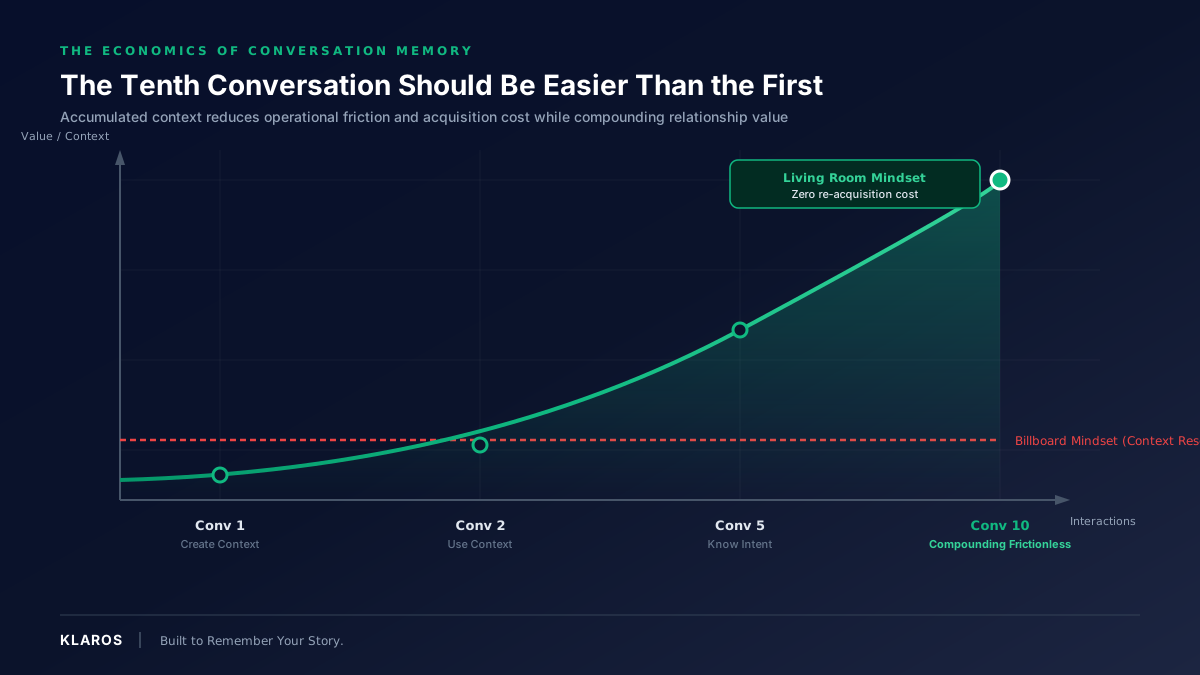
Because the tenth conversation should be easier than the first. Not identical to it.

The Tenth Conversation Should Be Easier Than the First
A customer shouldn't have to become a stranger every time they return.
The first conversation creates context.
The second should use it.
The fifth should know more.
The tenth should feel different from the first. Not identical to it. Better.
This is where conversation memory becomes operationally useful.
Memory Is Not Enough
Remembering the conversation isn't the same as knowing what to do.
Context
What did the customer say?
Business truth
What is actually true right now?
Decision
What should happen?
Authorization
Is the business allowed to do it?
Execution
Can the system actually do it?
Verification
Did it happen?
A conversational system shouldn't merely generate an answer. It should be able to ground a decision, execute an authorized action and verify the result.

Automation Without Memory Scales the Wrong Thing
Automation is powerful.
But automation without context simply allows a business to make the same mistake faster.
A faster forgotten promise is still a forgotten promise.
Apply this lens to broadcasts, sequences, cart reminders & interactive flows, templates, follow-ups, customer support and AI assistants. The question is not whether these mechanisms are useful; it is whether they operate with enough context to make the next interaction more useful.
The Economics of Remembering
The traditional loop often looks like acquisition → message → click → campaign → repeat.
A memory-driven conversation can instead compound: acquisition → conversation → context → decision → outcome → better next conversation.
The opportunity is not simply sending fewer messages. It is reducing the repeated operational cost of reacquiring context, recovering broken journeys and making subsequent interactions more relevant. See our cost calculator & economics model for messaging cost context.
What We Are Building at Klaros
Klaros is built around a simple idea:
The customer conversation should become more useful over time.
We think the next generation of WhatsApp infrastructure needs to do more than send messages.
- Remember context.
- Understand business state.
- Make decisions.
- Execute authorized actions.
- Verify outcomes.
- Carry what it learned into the next conversation.
This is the direction behind Klaros: a decision-and-execution layer for customer conversations, where customer context, business truth, authorized actions and verified outcomes work together. Discover our Philosophy and read our Compare matrix against conventional tools.
Five Questions to Ask About Your WhatsApp Strategy
- Are we optimizing messages or conversations?
- Does the system remember what the customer told us?
- Can it distinguish what was promised from what actually happened?
- Can it take the next authorized action?
- Does every conversation make the next one better?
The Future Isn't More Messages
Maybe the future of WhatsApp isn't more messages.
Maybe it's fewer messages that know more.
Less broadcasting.
More remembering.
Less optimization for the send.
More intelligence about the next decision.
Anyone can broadcast.
Anyone can automate.
Anyone can generate another message.
The hard part is knowing what should happen next.
Restraint is Revenue.
The winning metric isn't Message Volume.
It's Permission Duration.
The businesses that win won't be the ones shouting loudest into the room.
They'll be the ones who, when a customer replies, actually remember why.
Built to Remember Your Story.
Ready for conversations that remember?
Klaros provides a decision-and-execution layer for WhatsApp conversations. Built to remember customer story, connect live business truth, and execute verified outcomes directly on your own infrastructure.
+91 97893 77634 · Klaros — Built to Remember Your Story.
Questions about the Living Room mindset and WhatsApp context memory
What is the Living Room mindset for WhatsApp Business?
The Living Room mindset is the practice of treating customer conversations on WhatsApp as accumulated context and persistent memory rather than isolated, transactional broadcast messages. It shifts focus from message volume and reach to conversation continuity and relationship depth.
What is the cost of forgetting in customer conversations?
The cost of forgetting is the operational and commercial friction created when a business repeatedly reacquires customer context it already possessed. Every time a customer must restate an item, order detail, or prior agreement, friction rises and revenue leaks.
Why should the tenth conversation be easier than the first?
Because a business accumulates context with every interaction. The first conversation establishes intent and history; subsequent conversations should build on that ground truth so returning customers experience seamless, personalized continuity rather than starting from zero.
Why is memory alone insufficient for automated conversational systems?
Remembering what a customer said is useless unless the system can evaluate current business truth, verify authorization, execute a real business action (like generating a dynamic payment link or updating inventory), and verify the outcome.
How does Klaros act as a decision and execution layer for WhatsApp?
Klaros connects conversation memory with live business state, allowed actions, and outcome verification. Rather than just generating text replies, Klaros validates business constraints and executes authorized workflows directly on WhatsApp infrastructure.
Written 22 September 2026. Klaros — Built to Remember Your Story. Related: our philosophy, Klaros AI maturity framework, all build notes.